- The Money Trails
- Posts
- Why Venezuela’s Oil Scares Big Oil
Why Venezuela’s Oil Scares Big Oil
Trump Administration wants Venezuela’s oil. But Big Oil sees a minefield of risk, cost, and history.


Kartik Vyas & Gen Kimura
January 15, 2026

 |  |  |
What’s in This Week’s Issue…
Good morning. For years, Venezuela’s oil was treated as irrelevant. Not because it was small. Not because it didn’t matter. But because it was considered unusable.
That changed overnight.
After the U.S. operation that removed Nicolás Maduro, the Trump administration made its position clear: Venezuela’s oil would now fall back into America’s sphere. U.S. companies would extract it, and U.S. interests would control it.
On paper, it looked like the cleanest energy win imaginable. But in reality, it triggered a quiet backlash from Big Oil itself.
So this week…
🏆 The Big Play: Why Venezuela presents a big headache for Big Oil
💪 The Power Move: Why owning an asset isn’t the same as controlling its value
💵 Follow the Money: Will the US strike Iran?
-GEN
🏆 The Big Play
The biggest money power story of the week.
Why Venezuela Presents a Big Headache for Big Oil

Worldwide proven crude oil reserves (as of 2023)
At first glance, Venezuela looks like the ultimate prize:
The largest proven oil reserves on Earth (~300 billion barrels), more oil than Saudi Arabia, Russia, or the U.S, Gulf Coast refineries built specifically for this crude, and a U.S. administration openly willing to apply political and military pressure
If oil were just about reserves, this story would already be over. But oil is never just about reserves.
And to understand why Venezuela scares Big Oil, you need to understand three uncomfortable realities:
1. The biggest oil reserves in the world don’t produce much oil
Venezuela owns nearly 20% of the world’s proven oil reserves.
Yet today, it produces less than 1 million barrels per day. At its peak, it produced more than three times that.
That gap is the first red flag.
Most of Venezuela’s oil sits in the Orinoco Belt and is extra‑heavy, high‑sulfur crude, which means:
It barely flows at room temperature
It must be blended with lighter oil just to move
It trades at a steep discount
It requires specialized refineries
Without imported diluents, Venezuela’s oil is effectively stuck underground.
So while the reserves look massive, the economically usable portion is far smaller.
Big Oil understands this distinction. Governments usually don’t.

Key oil and mining sectors in Venezuela
2. Venezuela didn’t lose oil. It destroyed the system around it
Venezuela’s collapse wasn’t geological. It was institutional.
After a nationwide strike at the state-oil company PDVSA, Hugo Chávez purged tens of thousands of engineers and managers and replaced them with political loyalists.
For a while, high oil prices masked the damage. Then the system failed:
Wells went inactive → Pipelines corroded → Refineries broke down → Export terminals decayed → And skilled workers fled the country
Today, Venezuela has tens of thousands of inactive wells and non‑functional upgrading facilities.
Even worse, sanctions cut off financing, spare parts, and access to diluents.
The result is one of the great paradoxes of modern energy markets: A country with the world’s largest oil reserves that cannot produce oil without importing oil.
This is the machine Big Oil would inherit.
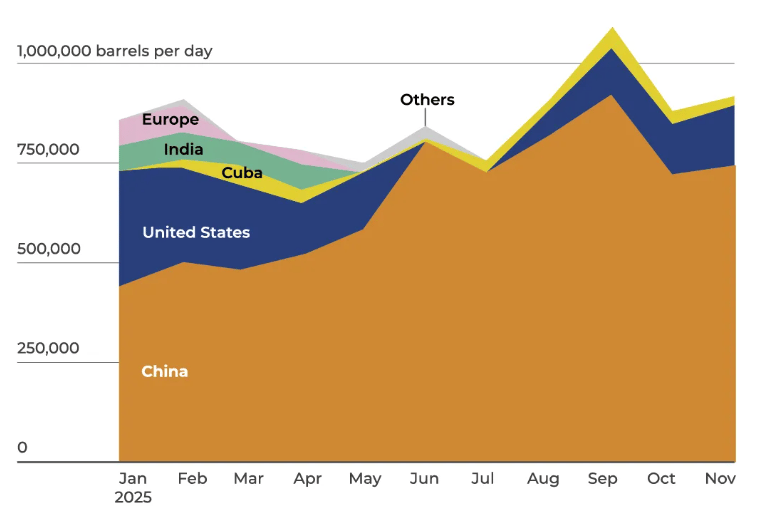
Importers of Venezuelan Oil (China buys most of its oil)
3. Why regime change doesn’t make Venezuela investable
From Washington’s perspective, removing Maduro solves the political problem.
From Big Oil’s perspective, it barely touches the commercial one.
Yes, regime change reduces Chinese and Russian influence, improves diplomatic influence, and removes a major sanctions bottleneck.
But oil companies invest on risk‑adjusted returns, not headlines.
And Venezuela still fails that test:
Contracts have been rewritten before
Assets have been nationalized twice in living memory
Arbitration awards remain unpaid
Legal protections are weak

Venezuela’s oil production
On top of that:
Reviving production would take $100B+ and a decade
Early capital goes into repairs, not profits
Heavy crude struggles at current oil prices
Supply chains remain fragile
This is why Big Oil pushed back quietly.
The upside is massive. The downside is existential.
And that imbalance is the headache.
💪 The Power Moves
Playbook for understanding the game of power.
Why Assets Alone Don’t Create Leverage

Venezuela’s assets
Venezuela’s oil story exposes a mistake that shows up far beyond geopolitics: owning something valuable is not the same thing as controlling what it’s worth.
Venezuela sits on the largest oil reserves on Earth, and yet those reserves don’t translate into power, stability, or leverage, because the system around them is broken.
The same pattern appears in markets, institutions, and even personal finance.
People focus on acquiring assets, titles, or positions, assuming ownership alone creates security. It doesn’t.
Value only emerges when the surrounding system works in your favor: rules you can trust, infrastructure that functions, and incentives that align.
When those conditions weaken, the asset doesn’t protect you. It traps you.
That’s the real lesson of Venezuela.
The oil didn’t fail. The system did.
The Takeaway:
Real leverage doesn’t come from what you own.
It comes from whether the system around it allows that ownership to work for you.
Before chasing the next asset, ask a harder question: who controls the rules that give it value?
💵 Following the Money
Three of the wildest financial and corruption stories from around the world.

Anti-regime protesters in Tehran, Iran
✨ Poll time!
Will U.S. control over Venezuelan oil ultimately benefit American energy security? |