- The Money Trails
- Posts
- Why Restaurants Keep Charging More for Worse Food
Why Restaurants Keep Charging More for Worse Food
How food distributors quietly eliminated restaurant choice across America


Kartik Vyas & Gen Kimura
December 25, 2025

 |  |  |
What’s in This Week’s Issue…
Good morning. Think about the last time you went out to eat and felt like something was off. The prices were higher, the portions were smaller. And somehow, no matter where you went, the food tasted similar.
You thought you were choosing between authentic local food and corporate chains, but that choice was an illusion.
A handful of companies control what ends up on 650,000 restaurant plates across America, from your corner diner to that white-tablecloth spot you save for special occasions.
So this week…
🏆 The Big Play: How three companies quietly captured 75% of America's food supply chain
💪 The Power Move: Why this consolidation reveals a bigger pattern destroying American culture
💵 Follow the Money: Why, really, is Trump going after Venezuela?
-GEN
🏆 The Big Play
The biggest money power story of the week.
Why Restaurants Keep Charging More for Worse Food

The Big Food
Everyone loves blaming private equity for ruining restaurants.
They buy chains, load them with debt, cut staff, and swap fresh ingredients for frozen mediocrity. Yes, that’s real.
But private equity only owns 10% of restaurants.
If food is getting worse everywhere, then the real issue isn’t who owns the restaurants. It’s who feeds them:
1. The Supply Chain Stranglehold
For most of the 20th century, restaurants bought ingredients from local suppliers, butchers, and small distributors.
Today, that model has been quietly replaced by broadline distributors. Think Costco for restaurants, but with monopoly power:
Founded in 1969, Sysco has acquired over 150 smaller companies and rolled them into a food empire. They now control the game.
Sysco and US Foods control 75% of food distribution, serving 450,000 restaurants plus 200,000 hotels, hospitals, schools, and prisons.
In 2015, regulators stopped Sysco from merging with US Foods because they would have controlled three-quarters of the national market.
This means there’s a very good chance you’ve eaten Sysco food without knowing it.
That "homemade" dish at your neighborhood spot probably came from the same factory supplying prison cafeterias.
Once supply consolidates, taste follows. And that’s where the second force tightens the vise.
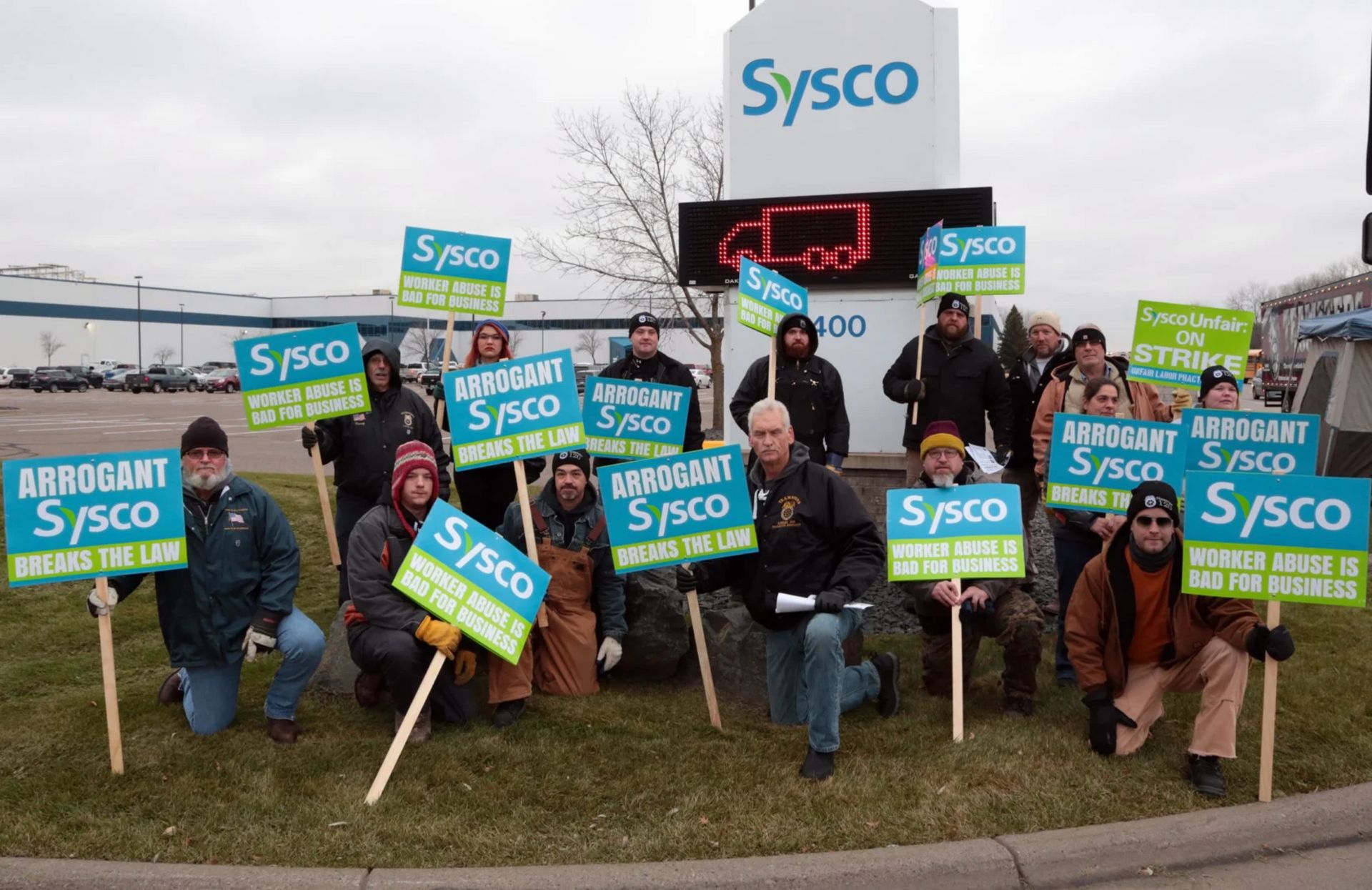
A Sysco workers protest
2. The Convenience Trap Tightens
Running a restaurant is a brutal business with razor-thin margins and chronic staffing shortages.
Sysco knows exactly who they're selling to, and they've created the perfect solution for desperate restaurant owners:
They sell Pre-everything, from pre-baked bread, pre-made sauces, to pre-grilled steaks that just need reheating.
Overworked, underpaid staff can serve more customers with less skill, resulting in labor savings.
And small restaurants, especially in rural areas, have zero negotiating power because they have nowhere else to go.
Even fine dining restaurants are demanding pre-cut, pre-washed, and pre-prepped items.
So, when the inputs are identical, the outputs start tasting identical. The only difference is the restaurant sign and interior design.

Dining out remains more expensive
3. The Economic Horseshoe Effect
Just like America's disappearing middle class, mid-tier restaurants are vanishing.
What's left are increasingly polar opposites between fast food and luxury dining:
Inflation makes eating out a luxury, so families either grab fast food or splurge on special occasions.
Local restaurants without centralized prep kitchens or Wall Street money get crushed from both sides.
Cava, Sweetgreen, and Chipotle occupy the exact real estate that used to belong to actual restaurants
And here's the kicker: BlackRock and Vanguard have significant ownership stakes in all three slop bowl chains.
The same asset management companies whose workers rely on these bowls for lunch.
With the same supplier feeding them, the extremes are bending toward each other and melting into one giant slop bowl of identical corporate investors, suppliers, and templated concepts.
💪 The Power Moves
Playbook for understanding the game of power.
Why This Goes Beyond Food

There’s some hope!
This isn't just about food. It's about the systematic elimination of shared American experiences.
That family-owned diner wasn't just a place to eat. It was a third place where communities gathered, where people from different backgrounds sat at the same counter.
As consolidation eliminates competition, we're not just paying more for worse food. We're losing the ritual that everyone could participate in.
And we've quietly accepted this mediocrity in exchange for convenience. We normalized it in airlines, housing, entertainment, and now food.
But there's hope:
Unlike housing or airlines, where you're stuck with limited options, food is one area where you actually have a choice.
Sweetgreen's stock is down almost 90% after its IPO.
Chipotle and Cava are tremendously down from their highs because people don't want to pay $17 for soulless mush.
The Takeaway:
The monopoly feeding America's restaurants has turned dining into a utilitarian transaction.
But every dollar you spend at a local restaurant that's fighting to maintain authenticity is a vote against the monoculture.
And in a country this divided, these shared experiences might be the last thing we can afford to lose.
💵 Following the Money
Three of the wildest financial and corruption stories from around the world.

What it’s really about?
✨ Poll time!
Do you feel like restaurants across cities now look and taste increasingly the same? |


