- The Money Trails
- Posts
- How America's Economy Broke Without Crashing
How America's Economy Broke Without Crashing
The answer is in two separate economies within America


Kartik Vyas & Gen Kimura
March 19, 2026

 |  |  |
What’s in This Week’s Issue…
Good morning. The stock market just hit another all-time high. GDP is growing, unemployment is low, and every economic indicator is screaming success.
Yet 78% of Americans now view fast food as a luxury they can't afford.
Something fundamental has broken in the relationship between economic growth and economic reality. The numbers aren't lying, but they're not measuring what you think they are.
So this week…
🏆 The Big Play: How America quietly split into two separate economies
💪 The Power Move: Why making more money won't save you
💵 Follow the Money: Castro’s Cuba survived nearly 70 years. Could Trump be the one to take it down?
-GEN
🏆 The Big Play
The biggest money power story of the week.
A Tale of Two Economies of America
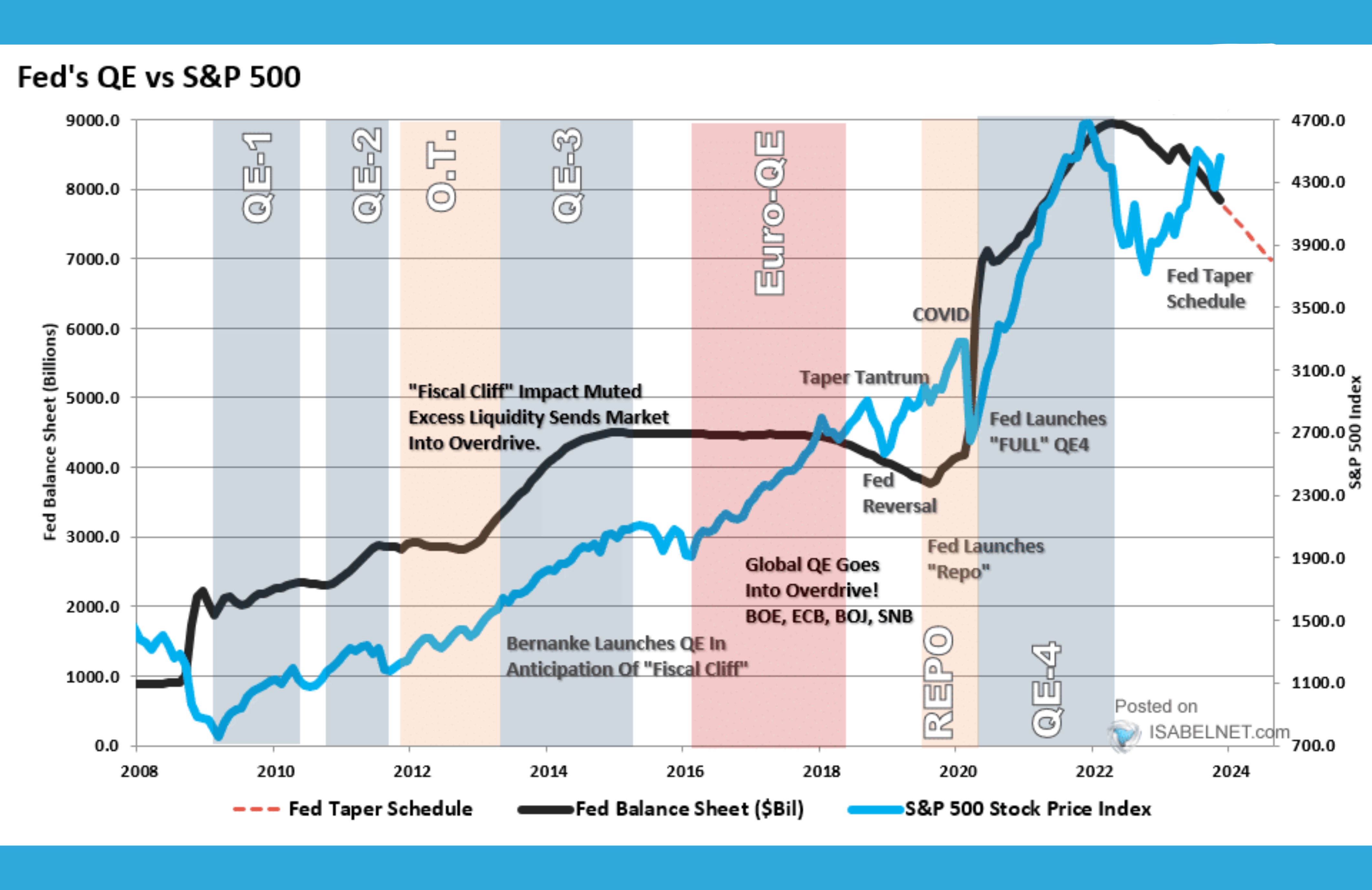
Fed Balance Sheet vs US S&P 500 Index
The stock market hasn't measured your life in almost a century.
What it measures instead is something far more specific: how much money a tiny slice of companies will extract in the future. The S&P 500 tracks 500 companies out of 30 million American businesses.
So when politicians point to record highs as proof of economic strength, they're showing you a scorecard that covers less than 0.002% of this playing field.
This disconnect isn't new. We've seen this exact movie before, and it always ends the same way.
1. The Addiction That Built Two Americas
Between 2008 and today, the Federal Reserve created an addiction that fundamentally rewired how wealth works in America:
The Fed's balance sheet exploded from $1 trillion to over $9 trillion through quantitative easing, pumping money directly into financial markets.
Every time they tried to pull back, the market crashed, forcing them to reverse course and pump even harder.
Stock prices ballooned not because companies got better, but because cheap money needed somewhere to go.
The feedback loop became permanent: The Fed prints money → Money floods into stocks → Stock owners feel richer → They spend more → That spending shows up in GDP → Politicians call it a strong economy → The market demands more, and the cycle repeats.
But here's what nobody tells you: while the Fed was pumping trillions into assets, wages barely moved.
The dollar you earned stayed flat while the assets you didn't own multiplied in value. This wasn't a bug in the system. This was the system working exactly as designed.

2. The Three Players Who Keep It Running
Start with the CEOs.
They engage in stock buybacks that were illegal until 1982, as a company using its own money to inflate its own stock price is obvious fraud.
But the rule changed, and buybacks became the most powerful tool in corporate America. 80% of CEO compensation now comes from stock awards and options. So when the stock price goes up, the CEO gets paid more.
But CEOs can't do this alone. They have bosses too:
BlackRock, Vanguard, and State Street, these three asset management firms control over $24 trillion and are the largest shareholders in 88% of S&P 500 companies.
They vote on CEO compensation packages and buyback programs on behalf of millions of investors.
These firms charge fees as a percentage of total assets under management. Every time stock prices rise through buybacks, their revenue automatically increases.
The third player writes the rules that protect everyone else. Politicians:
Nancy Pelosi's portfolio grew from roughly $700,000 in 1987 to $278 million today, a massive gain that crushes every major index.
She isn’t alone. Congress members consistently outperform professional money managers with access to information the rest of us will never see.
But the real protection comes from the Presidents. They now use the stock market as their primary scorecard for success.
Wall Street knows no president, regardless of party, can afford to let the market crash. And that’s how every CEO doing buybacks and every asset manager collecting fees operates with unlimited protection.
3. The Split You're Living Through
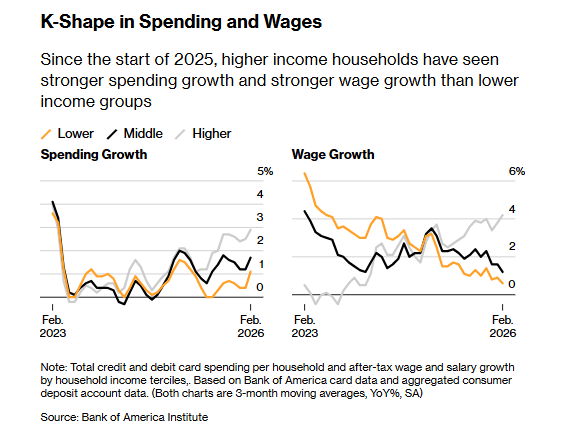
Economist Mark Zandi updated his data in September 2025 and discovered something terrifying about who's actually spending money in America.
The bottom 80% of Americans, those making less than $175,000 annually, have seen spending barely keep pace with inflation since the pandemic
The top 3.3% are doing "much, much, much better" in his words
Consumer spending makes up 70% of U.S. GDP, but 10% of people now drive 50% of all that spending
The numbers that measure economic strength are real. They're just measuring a different economy than the one you live in.
This is what economists call a K-shaped economy. One line goes up. The other goes down. Same system, opposite outcomes, depending on which side you're on.
The middle class, which used to be the backbone of this economy, made up 61% of Americans in 1971. Today it's 51%.
Most people falling out aren't moving up. They're sliding down to the bottom part of the K, and there's a reason the middle doesn't even appear on the chart anymore.
💪 The Power Moves
Playbook for understanding the game of power.
Why Ownership is the Only Way Out
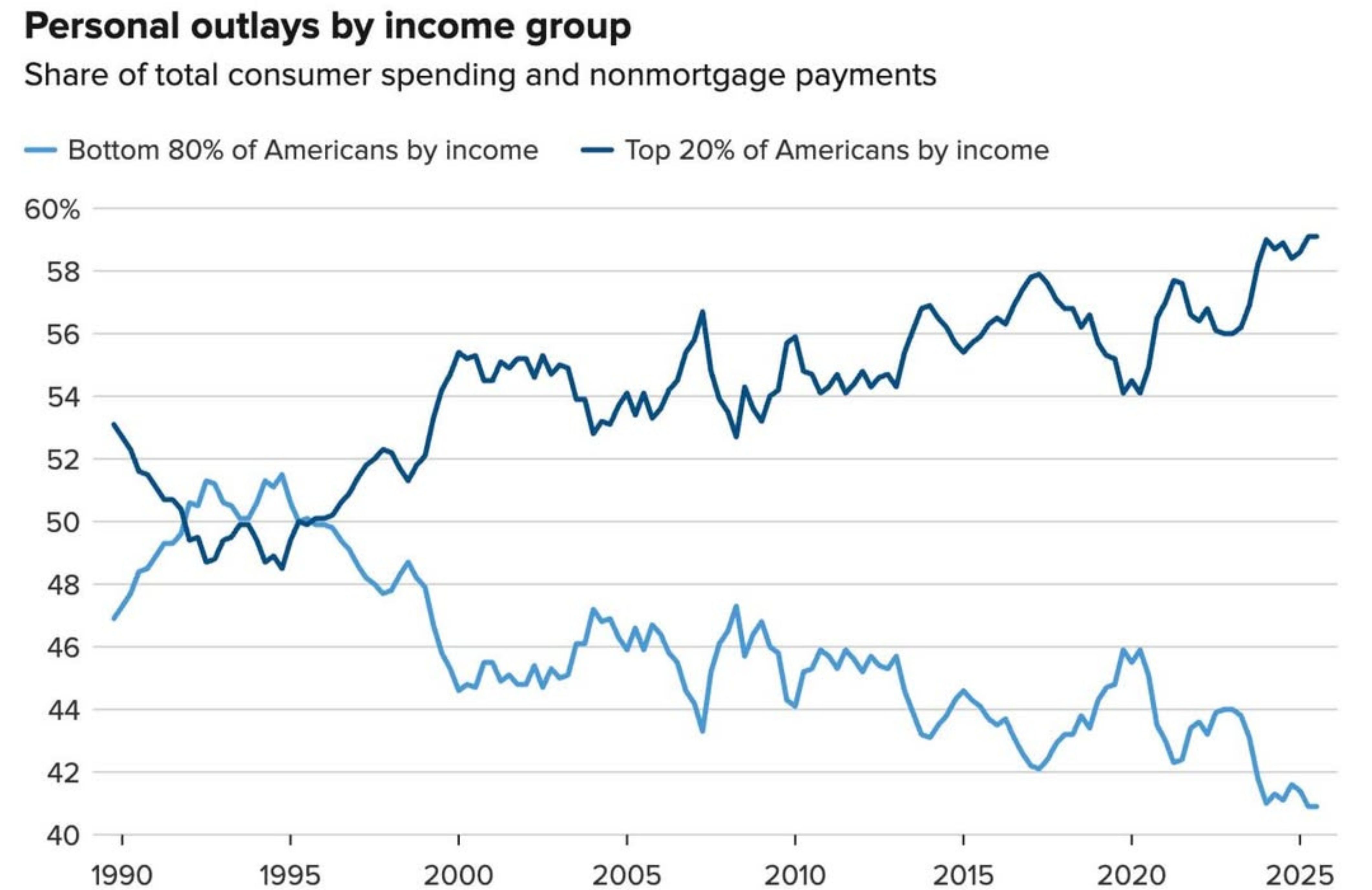
America’s growing consumer spending divide
The system isn't broken. It's working exactly as designed. And once you see that, you can start to use it.
The difference between the two economies isn't income. It's ownership. Forty-one percent of people making between $300,000 to $500,000 a year say they're living paycheck to paycheck. Roughly 40% of people making over $500,000 say the same thing.
If you own assets, the current carries you. If you don't, no matter how much you make or how hard you work, it will always pull away from you.
This isn't about giving up or accepting defeat. It's about understanding the game well enough to play it on your terms. The people running this economy are addicted to a loop: print money, inflate assets, repeat. That loop isn't going anywhere.
So the question isn't whether the system will change. It's whether you'll position yourself to benefit from it instead of being crushed by it.
The Takeaway:
The economy you see on the news and the economy you live in are no longer the same thing. One measures asset inflation for the few. The other measures survival for everyone else.
And the only way out of the permanent underclass is to stop trading time for money and start owning the assets the system is designed to inflate. That door is still open wider in America than anywhere else on Earth. But it's getting narrower every day.
💵 Following the Money
Three of the wildest financial and corruption stories from around the world.
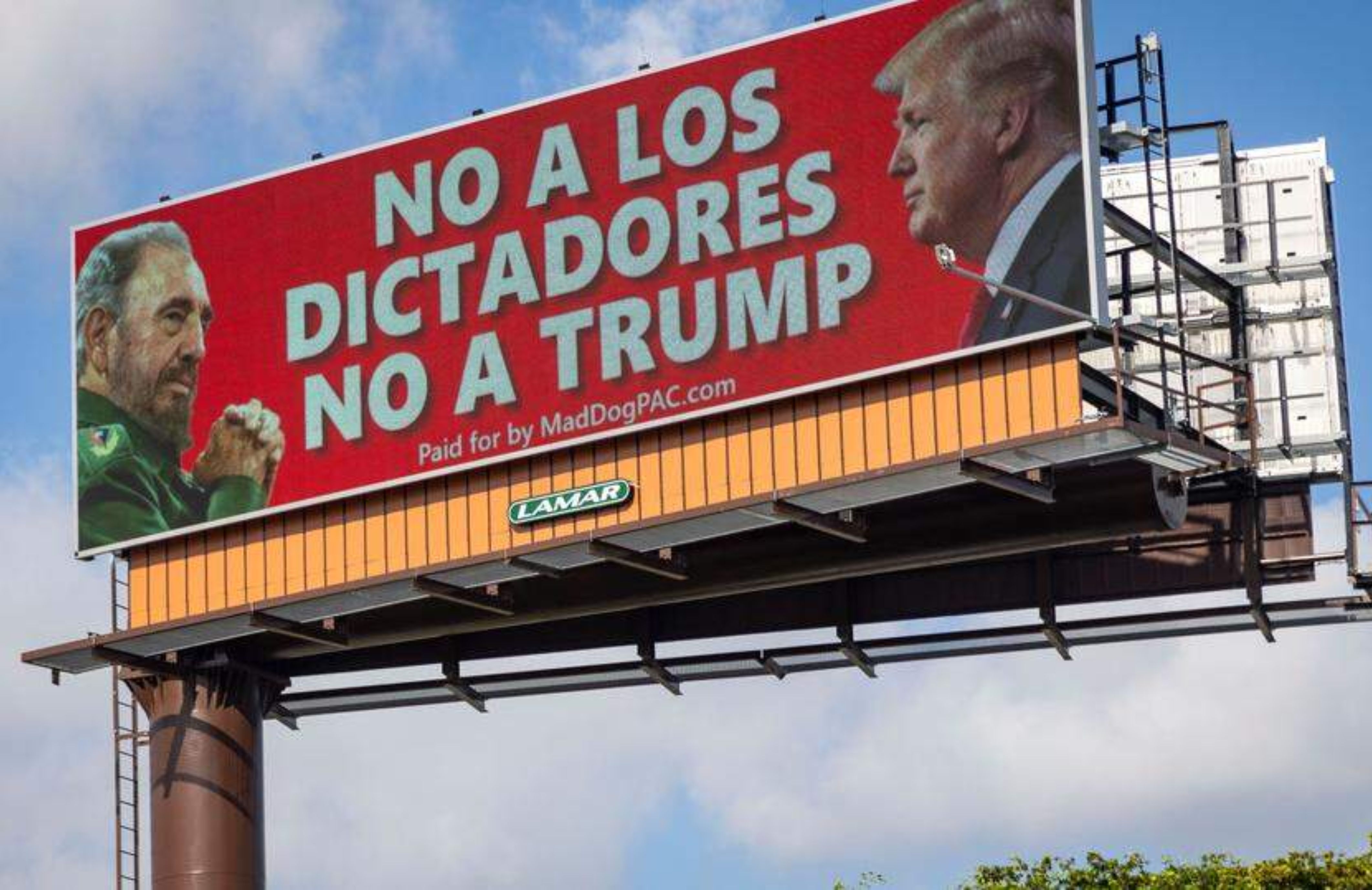
A 2024 billboard in Miami comparing President Trump to Fidel Castro
✨ Poll time!
Do you think you’re currently on the “winning” side of this economy? |


